
Orbit's Amazon Prime: Inversion's Arc Blasts Off Global Delivery Dreams – Cargo Anywhere in Under 60 Minutes!

By Eugene@BreakingNews4𝕏
October 2, 2025
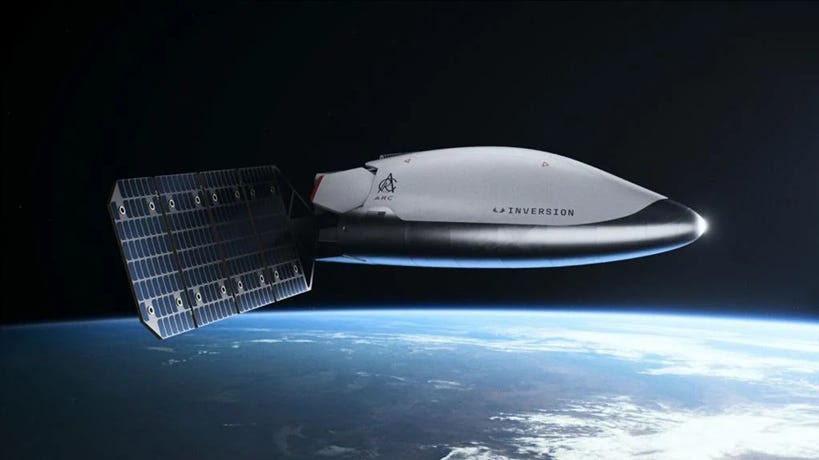
Imagine this: A drone drops medical supplies in a war zone, or fresh intel gear lands in a remote disaster area – all from the stars, zipping down like a cosmic courier in less than an hour. That’s the audacious promise of Arc, the sleek new spacecraft unveiled Wednesday night by Inversion Space during a star-studded bash at their Los Angeles factory. The 60-strong startup, hell-bent on turning low-Earth orbit into the ultimate express lane, introduced Arc as the world’s first space-based delivery vehicle – autonomous, reusable, and ready to hurl up to 500 pounds of cargo to any pinpoint on the planet with hypersonic haste
.
In a gleaming hangar aglow with spotlights and the hum of innovation, co-founders Justin Fiaschetti and Austin Briggs – both dropouts from Boston University with pedigrees from SpaceX and Relativity Space – pulled back the curtain on their brainchild. Arc isn’t your grandma’s rocket; it’s a lifting-body beast designed for precision drops, pre-positioned in orbit for years on end, then summoned like a loyal falcon to deorbit, blaze through reentry at blistering speeds, and parachute softly to earth – no runway required, thanks to non-toxic propellants that let ground crews swarm it sans hazmat suits. “The nominal mission for us is pre-positioning Arcs on orbit, and having them stay up there for up to five years, able to be called upon and then autonomously go and land wherever and whenever they’re needed,” Fiaschetti beamed to the crowd, his voice cutting through cheers. “Being able to bring their cargo or effects to the desired location in under an hour.”
Backed by heavyweights like Lockheed Martin and Spark Capital, Inversion’s not just daydreaming – they’ve already lofted a 200-pound demo called Ray aboard SpaceX’s Transporter-12 mission in January, proving the orbital chops with power-positive ops and trajectory tweaks. Arc amps it up: A versatile payload bay swallows everything from blood plasma to battlefield drones, forming customizable constellations in low-Earth orbit for tailored ops. On demand, it dives – maneuvering with a 1,000 km cross-range swagger – then deploys an AI-driven parachute rig for pinpoint landings within feet of target, powered by Inversion’s homebrew flight computer blending computer vision and nav smarts.
The military angle? It’s the secret sauce. Arc eyes U.S. defense needs first, zapping mission-critical gear to denied zones or austere outposts where trucks fear to tread – think rapid resupply before the “fight is over,” as Fiaschetti put it. But the vision stretches civilian: Disaster relief, urgent meds, even hypersonic testing for tech that thrives in the fire of reentry. “The true economic value of space is accessing the globe... with physical cargo, rather than with just data,” the CEO mused, underscoring why he ditched college for this orbital odyssey.
X lit up like a Falcon 9 launch post-reveal, with Inversion’s teaser video racking 4,800+ likes and 500+ reposts in hours. Ars Technica’s Eric Berger dubbed it “a really innovative concept for space cargo delivery,” pondering if the upstart can deliver amid the skeptics. Japanese space watchers geeked out over the “unique” defense twist, while serial entrepreneurs hailed the biz model: Pre-stock via cheap rideshares from SpaceX or Rocket Lab, then autonomous drops for emergency hauls. One Perplexity AI thread even framed it as the dawn of point-to-point space logistics, echoing DoD dreams.
Progress? It’s pedal-to-the-metal: A full-scale structure mockup’s done, drop tests nailed, sims aced, and NASA’s in on next-gen heat shields for hellish reentries. First orbital hop? Locked for late 2026, with Lockheed’s fingerprints ensuring it’s no pipe dream. Yet challenges loom – orbital decay, precision in storms, regulatory red tape – but Fiaschetti’s undeterred: “Does this make a difference in the moment it’s needed?” For troops, docs, or that midnight snack run, Arc bets yes.
Inversion’s gambit could flip space from satellite silo to global FedEx on steroids, proving the final frontier’s ripe for rush-hour runs. As constellations cluster and drops multiply, one drop at a time, the world just got a whole lot smaller – and a heck of a lot faster.
Eugene@BreakingNews4𝕏 is breaking down the chaos of innovation, one viral headline at a time. Follow for unfiltered takes on Tesla, AI, and the future.